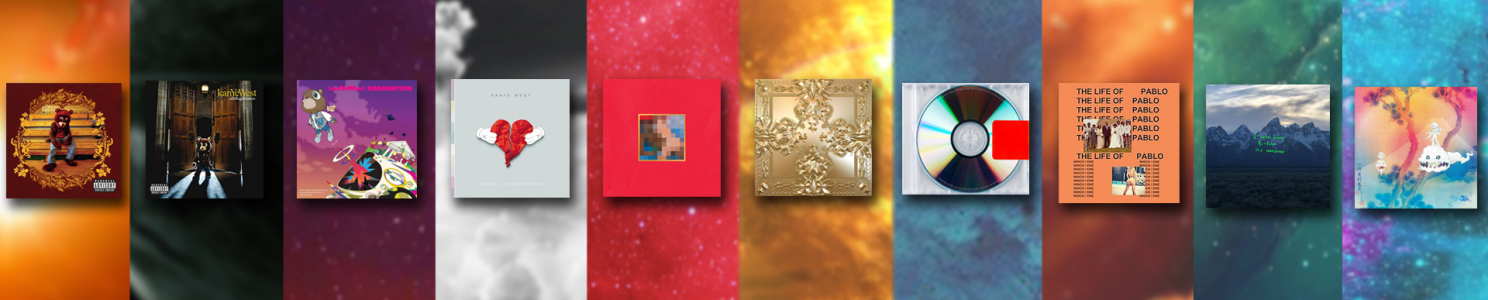
Every Kanye album, what it signifies, what it does right (and wrong, occasionally), and its influence on Ye, rap and the music industry in general. I’ll focus on the musical elements, because lyrical themes are much discussed elsewhere and I find that Kanye’s production style is at the core of everything he does.
This will be updated as I move chronologically.
The College Dropout
Kanye’s true introduction into the rapping world, TCD is beloved as a nostalgic symbol of something Kanye once was: The fresh kid on the block, unencumbered by upper-echelon celebrity and the pressure to repeat success. Pessimistic fans and critics romanticize a supposed innocence from the time, as though Kanye didn’t show many of the same characteristics then as he does now.
TCD serves as the base of Ye’s musical ideology. He famously “chopped up the soul,” as he later jokes on “I Love Kanye” on The Life of Pablo. By using soul-influenced samples behind his own rapping and various features, he lays the roots for the musical ideas that still drive him: The diversified production, the use of the human voice, and the complete departure from gangsta rap that permeated hip-hip.
It is rough around the edges compared to other Kanye albums. He was still developing and learning as a producer and rapper; he was a rookie, after all. “Breathe In Breathe Out” doesn’t quite fit, though Ye’s rapping is good on that track. I still don’t get “The New Workout Plan,” and “School Spirit” doesn’t reach the listenability of other Kanye songs. “Get Em High” and “Never Let Me Down” aren’t perfect.
But it was on another level from what other rappers were doing, and it won best rap album at the Grammys. “All Falls Down” is amazing, especially lyrically. “Jesus Walks” made him popular and disseminated some of Kanye’s ideologies to a wider audience. Fans cherish “Family Business,” a delightful ode to his family with darker, not-so-subtle undertones.
TCD set the stage for further musical wizardry. It remains influential, as Kanye’s first testament (of many) to how rap can maximize its potential as a genre. Much of rap’s saturation into modern pop music can be attributed to the initial growth that TCD spurred.
Late Registration
Kanye grows. He softens those rough edges and produces an album with more songs closer to “All Falls Down” than “Get Em High.” He incorporates orchestral music, a fascinating progression and the first symbol of his willingness to change and adapt. He felt the need to prove he was more than soul samples and he accomplished it emphatically.
“Touch The Sky,” both “Diamonds From Sierra Leone,” (though in my opinion the original is superior to the Jay Z remix), “Gone,” “Late,” and “Heard ‘Em Say” are more refined and more diverse production-wise than much of TCD. His lyrics remain thoughtful — listen to “Roses” and “Bring Me Down” for evidence — and he advances the album with music that successfully toes the line between maintaining TCD’s success and introducing new and improved concepts.
He continues the education theme, though he relaxes his intense, satirically-tinted criticism of the school system and society’s view of it. Kanye’s need to represent counter-culture while simultaneously driving culture itself forward is always present.
Graduation
Gradation presents the greatest stylistic change up to this point. No longer does Kanye include spoken interludes or sprinkle old guard-tinted, rap-heavy songs like “Drive Slow” and “We Major.” Apart from Lil Wayne and Coldplay’s Chris Martin, the listener hears just one voice throughout.
On the surface, Graduation seems like a pivot to pop. But the more refined, pleasurable sounds are a calculated move toward a concert-friendly feel, inspired by Kanye’s 2005 tour with U2. That style has been hugely influential since, making Graduation arguably Kanye’s second-most influential album.
Across the board, it fits its name: Graduation is Kanye’s step away from his first two albums, which were far more similar to each other than to his third album. This record is Kanye graduating, so to speak, into a higher-level, evolving music style that will last through Yeezus.
He breaks the pop charts with “Stronger” (which is our first look at the auto-tune he debuts in 808s) and presents upbeat records like “Champion,” “Good Life” and “The Glory,” the latter of which features one of Kanye’s best samples. “I Wonder” and “Everything I Am” are slower and more thoughtful, but they maintain a stadium-friendly feel. “Homecoming” and “Good Morning” are nice bookending songs.
“Flashing Lights” accurately represents what the whole of the album is: a joyful experiment with new, pleasurable sounds and rapping tailored toward the music. Graduation was Kanye’s happiest record, made with a thrilled anticipation of playing these songs in concert. That never truly came to fruition, however, and due to extenuating circumstances, we haven’t seen Kanye return to this level of happiness in his music.
808s and Heartbreak
Kanye produced 808s and Heartbreak, a tragic piece of auto-tune and 808 drums, in the immediate aftermath of two major personal shocks: his mother, Donda, passed away suddenly from a failed surgery in her late 50s; and his engagement with Alexis Phifer was broken off just months later. His much-anticipated Graduation tour was cut short and Kanye sunk himself into new music.
Rapping could not accurately convey his feelings, and the Graduation-style stadium music certainly couldn’t either. Kanye instead wanted to sing. He realized, though, that he was not a great singer on his own, and so he compensated with the heavy use of auto-tune, which had never been adopted in this way before. His adjusted voice ultimately expressed his mournful feelings in a way nothing else could.
808s became an incredibly emotional piece of work, with long, somber instrumentals on “Say You Will” and “Bad News” and amazing contrasts of sad lyrics and more upbeat sounds on “Paranoid,” “Heartless,” and “Robocop.”
The two features on the album — Young Jeezy on “Amazing” and Lil Wayne on “See You In My Nightmares” — fit well, maintaining the sorrowful, sing-songy feel. Kid Cudi, perfect for all of this, broke out on “Welcome to Heartbreak.”
In a lot of ways, this was Kanye’s most refined piece of work. There were no “Barry Bonds” and “Drunk and Hot Girls” on this record. 808s was controversial when it came out, but it could very well be Kanye’s second-best album.
Its influence on the music industry cannot be overstated. It opened the door for Drake, The Weeknd and so many other artists to auto-tune their voices with hip-hop beats, allowing further permeation of hip-hop into the pop music lexicon. “Heartless,” the biggest pop hit on 808s, seems like the base form of many radio hits.
Auto-tune has become overused and a fallback, but Kanye understood its benefits and maximized it, realizing the ways it fit perfectly with his feelings at the time. This is the most prominent example of Kanye pouring his emotions into his music, to industry-changing effect.
My Beautiful Dark Twisted Fantasy
MBDTF is Kanye’s magnum opus, a statement to the world of his musical artistry. The album, as has become a theme, came at a time of personal troubles, again heavily influencing Kanye’s approach. The Taylor Swift incident tanked the public’s perception of him, and 808s had not been received as well as his prior, more conventional albums. Kanye approached this 2010 record with the stated goal of making the best music possible.
It would be innovative, but not to the specific extent of Graduation or 808s. MBDTF didn’t have some defining feature that changed the way hip hop and pop music operate; instead, it incorporated a variety of elements that coalesce to form a deep, pleasurable collection of songs, the result of Kanye’s half-decade-long development from a raw, forward-thinking artist into a true all-time great.
To battle a sunken reputation, Kanye shuttered himself in Hawaii and invited a host of rappers and producers to aid this project. A whole lot of music emerged — in addition to the album and a Beyonce-infused bonus track, Kanye crafted the G.O.O.D. Fridays songs, a collection of high-quality records that fit the style of the album, with some of the same talent.
It appears that to Kanye, a best-possible album would include songs of a longer length, with profound and diverse production and a healthy mix of rapping and singing. The goal became a maximalism approach.
The list of contributors is an all-star team: Beyonce, Jay-Z, Pusha T, Justin Vernon, Kid Cudi, Rihanna, Raekwon, Rick Ross, Nicki Minaj, John Legend, Drake, Elton John(!), Alicia Keys, RZA, and more than a few others. High-profile producers like Mike Dean and No I.D. played big roles. Rarely has such a huge amount of talent in a single industry worked together at one time.
The result was Kanye’s best album, an exhibition of hip-hop-rooted music and vast production styles. Kanye put everything together for Dark Fantasy. “Gorgeous” features a deep, orchestral guitar behind crooning Kid Cudi vocals and well-crafted social commentary. “Monster” runs at 6:18 and includes memorable verses from Kanye, Jay-Z and Minaj, plus vocals from Vernon. “Devil in a New Dress” (the best song title ever) is classic Kanye production, with a Smokey Robinson sample driving a lovely beat. With Kanye’s lyrics, Dean’s transcendent guitar solo and Rick Ross’s magisterial verse, DIAND has an argument as Kanye’s greatest song.
MBDTF combines everything Kanye had done in his first four albums, with sampling reminiscent of The College Dropout, orchestra sounds of Late Registration, stadium music of Graduation, even the auto-tune of 808s. The lyrics are better than anything he’d come up with before.
On “Power,” he sums himself up in a few verses — “my childlike creativity, purity and honesty is honestly being crowded by these grown thoughts.” “Dark Fantasy” is the perfect intro, with massive Vernon vocals surrounded by clever Kanye wordplay. “So Appalled” contains great rapping (including peak Jay-Z) with production to back it up.
“Hell of a Life” and “Blame Game” go back to back, an interesting contrast of theme and musical style. “All of the Lights” tells a story of a troubled father amid an amazing soundscape, with Rihanna leading the chorus and Elton John playing the piano. “Lost in the World” punctuates it all with an outstanding Vernon-led chorus, finishing with the “Who Will Survive in America?” interlude.
There is plenty of lyrical commentary to be explored. Kanye understands the background of the album and touches on it throughout. Dark Fantasy contains the most exquisite lyricism of his career.
That brings us to “Runaway,” the best song of Kanye’s best album. The song contains multitudes, with Kanye toasting the “assholes” and recognizing that he can be one at times. It is self-reflective, possibly based on the report that President Obama had called Kanye an a-hole off camera after the Swift incident. Its complex production — from the iconic piano notes to the three-minute coda, with Kanye’s mangled voice functioning as a guitar — and Kanye’s lyrical contemplation, plus Pusha T’s intentionally villainous guest verse, encapsulate the album’s entire feel and style.
Kanye has never reached this level again, but there is no way he — or anyone else — would ever be able to, and Kanye seems to know it. He hasn’t bothered to try, instead relaxing a bit on the complex, maximalist production. MBDTF can stand alone as the only album of its kind, a record meant to be perfect that came as close to succeeding as any in history.
Watch the Throne
Nothing could adequately follow MBDTF, but Watch the Throne was an exuberant, upbeat realization of a dream for Kanye. He did a joint album with Jay-Z, producing most of it and sharing rapping duties equally. After reaching the mountaintop with Dark Fantasy, Kanye enjoys the fruits of his labor alongside a hip hop giant.
The content of the album largely surrounds the benefits of being rich and powerful. It’s an opulent statement of success, with the visual of Kanye and Jay-Z rapping in front of expensive sports cars and a pristinely blue sky symbolizing the album as a whole. There aren’t many musical barriers being broken here (a first for Kanye), but that wasn’t the point. This is a joyous encapsulation of how far Kanye and Jay-Z have come, and it’s intended to show how much fun high-level hip hop music can be.
Maximalist production sticks around. The samples are amazing — listen to “Otis” and “Gotta Have It” for proof — and a smaller cast of stars (Kid Cudi, Beyonce, Frank Ocean, Justin Vernon) contributes vocals. Many of the songs are long, with a variety of musical sounds backing Kanye and Jay’s verses.
There is significant introspection, even amid the lavishness. The duo addresses violence in the inner-cities (“Murder to Excellence”) and coming of age (“Made In America”). Jay-Z outright says he’s depressed, which is not something you’d expect to hear out of Jay-Z. On “New Day,” both rappers talk directly to their future sons.
Kanye says: “See, I just want him to have an easy life, not like Yeezy life. Just want him to be someone people like.” Kanye is recognizing his personal flaws, just as he did on “Runaway.”
We get plenty of clever wordplay and classic lines. “Sophisticated ignorance, write my curses in cursive” (“Otis”) is a highlight.
Kanye drives this album. His rapping is better than Jay-Z’s, and it’s Kanye’s ideas that produce the amazing samples and diverse musical output. There are a variety of styles and sounds happening, and while nothing reaches the level that MBDTF did in terms of pure musicality, WTT works because it’s two all-time greats casually putting out an extensive dual album.
One can debate the relevance this holds in Kanye’s wider discography. We can enjoy these two producing an enjoyable declaration of their talent.
Yeezus
Two years after the release of Watch the Throne (and a year after the release of the GOOD Music joint album Cruel Summer), Kanye felt the urge to innovate. Yeezus was a highly-anticipated album, the first solo work he’d released since the universally acclaimed Dark Fantasy, and there were significant expectations.
Characteristically, Kanye flipped the script and produced an album that seemingly contradicted every musical principle that had built MBDTF. A concise, aggressive album, Yeezus has (almost) none of the five and six minute songs that dotted his previous work. There was little ornamental instrumentation or pleasurable choruses. With Rick Rubin helping deconstruct the production, there was often only a couple of sounds happening at once.
One of the building blocks of Yeezus, and perhaps its most defining elements, are electronic bursts that adjust throughout the album. The first song, “On Sight,” blasts the listener with these metallic sounds, placing us in a brand new world of brash confidence and straightforward, in-your-face rapping.
Kanye’s propensity for rhythm and melody does not disappear, however. It merely manifests in a new musical style. Overtop the abrasive electronics are well-placed samples and an eclectic mix of guest singers. Most of the time, these samples are inserted to give life to the bursts. Other times, the samples are beautiful snippets, a wonderful contrast to the overall vibe of the album, and they give us a dose of the traditional musical artistry that Kanye is usually engaging in. These samples — which conclude “On Sight” and “New Slaves” and fill the album’s last track, “Bound 2” — feel significant for how displaced they initially feel, and for how satisfying they are amid such an unusual soundscape.
The rapping throughout the album is abnormal in Kanye’s discography for how straightforward and aggressive it is. Kanye’s usual style is nimble and rhythmic, dancing around the beat and moving with the melody to make the listening experience as pleasurable as possible. Yeezus is a bit different. When Kanye raps, his voice dominates — overtaking the sparse beats. It means that the lyrics are front and center.
With how intricate the narrative of this album is, it’s no accident that the lyrics take center stage. I won’t be able to fully describe the story Kanye tells here (listen to the Dissect podcast), but I can give you the gist: it’s the story of a fictionalized version of himself, Yeezus, who struggles with the allure of troublesome vices and ego while ultimately seeking a fulfilling relationship that brings him out of a dark place. Additionally, he sees problems in the world and must reconcile his desire to solve these problems while also solving himself.
Every song is a piece of the narrative. This is an approach that Kanye has taken with most of his albums, but it is clearest and most central on Yeezus. “Hold My Liquor” is one of the album’s highlights, and it tells the story of one of the Yeezus character’s failed relationships. “Bound 2” is the culmination, a love song only Kanye could come up with. Sonically and lyrically, it’s the light at the end of the tunnel, with the subtle recognition that Yeezus’s story is far from complete.
Elsewhere, Kanye uses an old Nina Simone sample on “Blood on the Leaves,” a masterpiece of a song that combines both Kanye’s history of chipmunk sampling and the new-age electronic bursts. “New Slaves” is the thesis statement for Kanye’s societal criticism on Yeezus.
The album received some blowback when it first came out. It has since been recognized as a classic, and one of the most innovative albums of the decade.
 I Feel Kinda Free